

Risk-Free: How Shopify Winter '26 Enables Testing Before Launch

Published December 15, 2025 | 8 min read | By CLEARgo
Quick Summary: Shopify Winter '26 introduces built-in testing capabilities through SimGym (AI simulation) and Rollouts (safe deployment). SimGym simulates shopper behavior using AI trained on billions of transactions. Rollouts enables A/B testing and gradual deployments. Combined, these tools enable risk-free innovation where businesses can test radical changes safely before customer exposure. This analysis helps stakeholders assess testing strategy implications.
Every store change carries risk. Major redesigns, pricing adjustments, checkout modifications, and campaign launches can improve performance or damage revenue. Traditional approach: launch and hope. Winter '26 approach: test and know.
For businesses evaluating Shopify, understanding built-in testing capabilities helps assess innovation risk tolerance and optimization potential. This guide examines how SimGym and Rollouts change testing economics and strategic planning.
Context: This is part of a strategic analysis series. See the complete platform evaluation guide for comprehensive assessment.
The Testing Transformation
Traditional Launch Model
Process:
- Design change based on intuition or best practices
- Build and QA internally
- Launch to all traffic immediately
- Monitor performance and hope for positive results
- Roll back if major problems emerge
Risk Profile:
- Full traffic exposure from moment one
- Revenue impact of bad decisions affects all customers
- No safety net beyond manual monitoring
- Conservative decision-making due to risk aversion
- Slow innovation cycles
Business Impact: Organizations avoid aggressive innovation because downside risk too high. Incremental changes only. Competitive disadvantage from slow evolution.
Winter '26 Testing Model
Process:
- Design change and test with SimGym AI shoppers first
- Get recommendations before real customer exposure
- Use Rollouts to test with small traffic percentage
- Scale gradually as confidence grows
- Instant rollback if issues detected
Risk Profile:
- AI simulation eliminates customer exposure during experimentation
- Gradual rollout limits downside to small traffic percentage
- Built-in safety mechanisms for instant recovery
- Data-driven decision making reduces intuition risk
- Faster innovation cycles with controlled risk
Business Impact: Organizations can test radical changes confidently. Aggressive innovation becomes viable. Competitive advantage from rapid optimization.
Strategic Implication
Built-in testing changes risk-reward calculus for innovation. Businesses must decide: Does testing capability justify platform choice? What innovation becomes possible with risk mitigation?
SimGym: AI-Powered Store Simulator
What SimGym Does
SimGym uses AI agents trained on data from billions of Shopify transactions to simulate shopper behavior on your store. It tests changes with virtual customers before real traffic exposure.
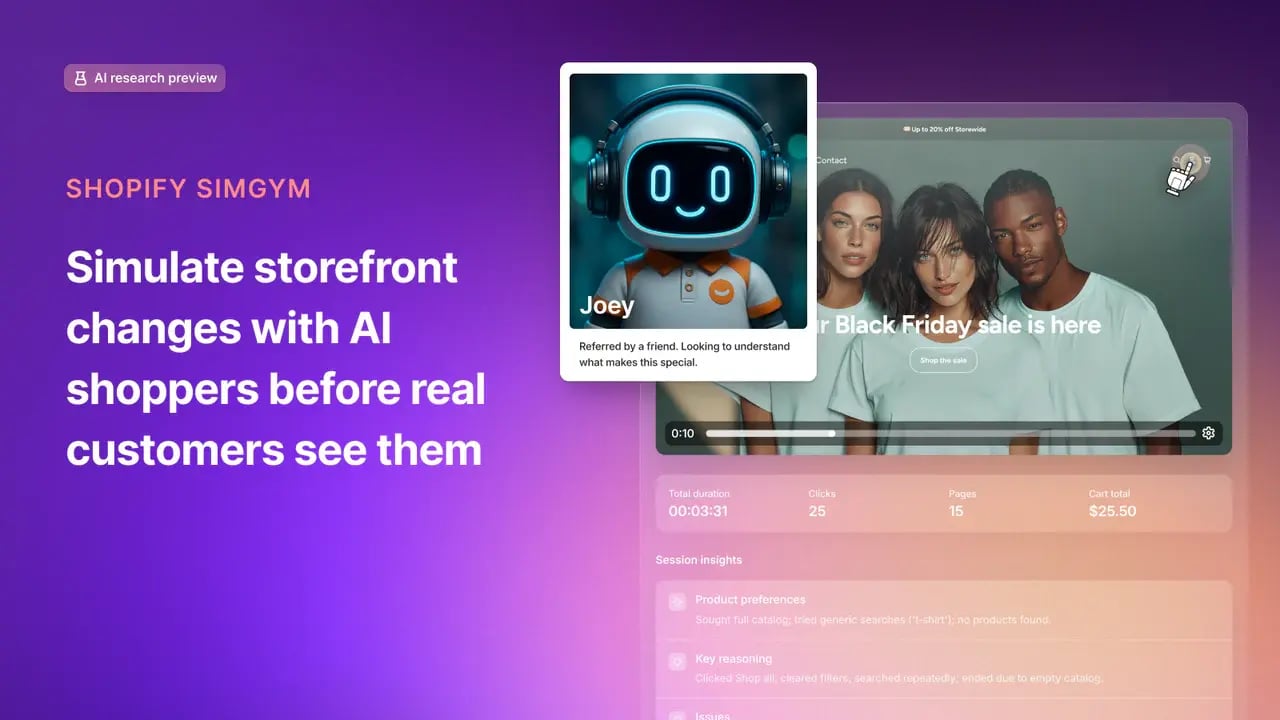
Core Capability:
Predict how changes will affect shopper behavior and conversion before launching to real customers.
How SimGym Works
Training Data:
- AI trained on billions of actual Shopify purchase transactions
- Patterns learned from diverse store types and customer behaviors
- Continuously updated with new transaction data
- Reflects real shopper decision-making patterns
Simulation Process:
- You specify what change to test
- SimGym creates AI shoppers matching your customer profile
- Virtual shoppers interact with changed version of store
- AI analyzes behavior patterns and outcomes
- SimGym provides actionable recommendations
Output:
Recommendations based on how AI shoppers responded to changes. Identifies potential improvements and concerns before customer impact.
What You Can Test With SimGym
Theme Changes:
- Major redesigns or layout modifications
- Product page structure variations
- Homepage hero section approaches
- Navigation architecture changes
- Mobile experience modifications
Pricing Strategies:
- Price point adjustments
- Discount structure variations
- Bundle pricing approaches
- Subscription pricing models
- Tiered pricing strategies
Checkout Optimization:
- Checkout flow modifications
- Form field changes
- Payment method positioning
- Trust signal placement
- Urgency element testing
Merchandising Approaches:
- Cross-sell and upsell strategies
- Product recommendation placements
- Category organization
- Search results presentation
- Promotional messaging
Business Impact
Risk Reduction:
Test radical ideas without customer exposure. Identify problems before they affect revenue. Validate assumptions with AI simulation.
Innovation Enablement:
Organizations can test aggressive changes that would be too risky without simulation. Expands range of viable experiments.
Speed Advantage:
Get directional guidance before building and launching to real traffic. Reduce wasted development on approaches that won't work.
Learning Acceleration:
Compress learning cycles. Test multiple approaches quickly to identify best direction before real-world implementation.
Rollouts: Safe Deployment System
What Rollouts Does
Rollouts provides built-in capability for scheduling theme changes, running A/B tests, and implementing gradual deployments directly in Shopify admin.
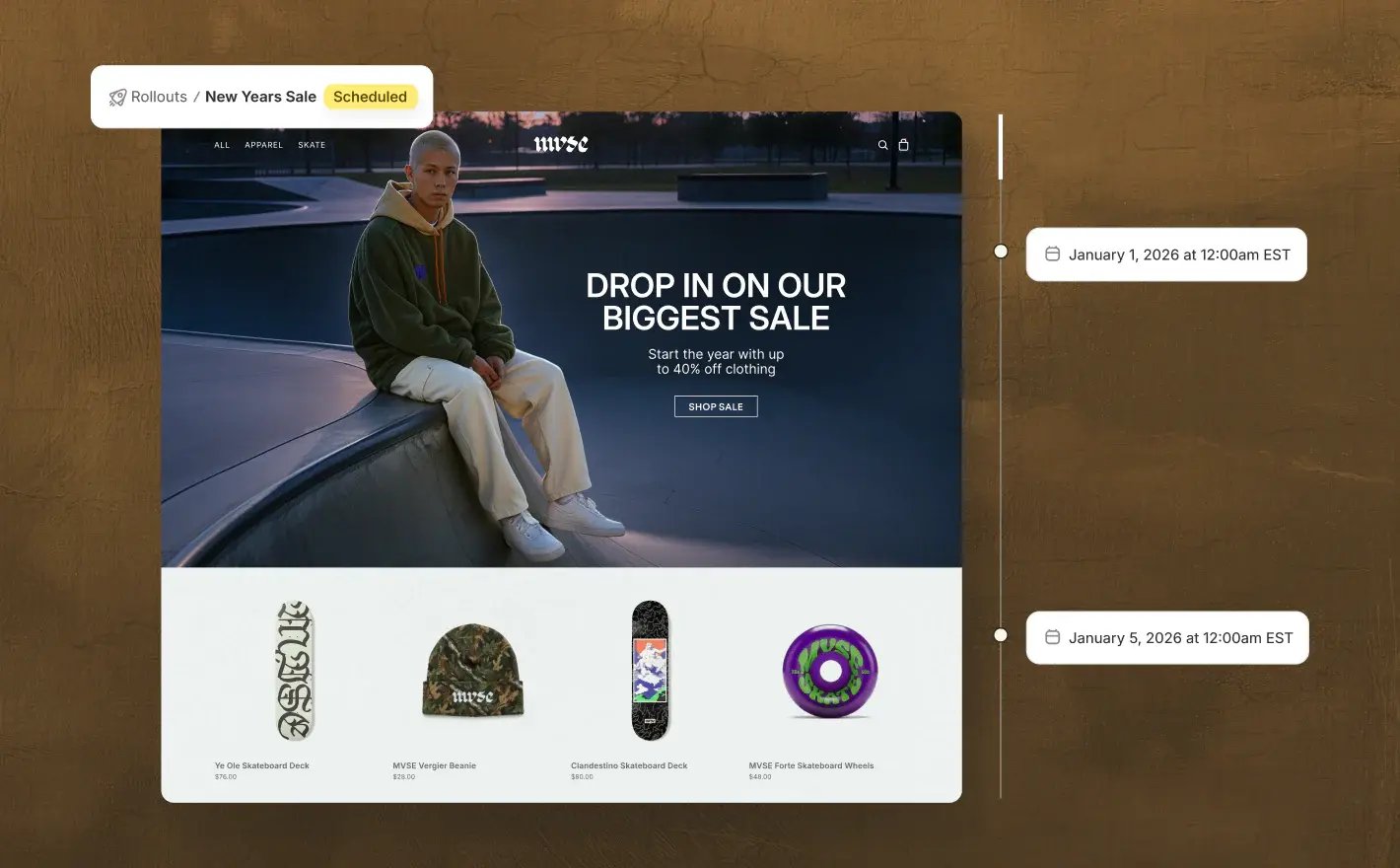
Core Capability:
Control exactly when changes launch, what percentage of traffic sees changes, and instant rollback if problems emerge.
How Rollouts Works
Scheduling:
- Set future deployment dates and times
- Coordinate changes with marketing campaigns
- Automate launch timing
- Remove manual deployment coordination
A/B Testing:
- Split traffic between control and variation
- Define success metrics
- Monitor performance in real-time
- Platform tracks statistical significance
- Make data-driven deployment decisions
Gradual Rollouts:
- Start with small traffic percentage
- Monitor performance and stability
- Increase percentage as confidence grows
- Scale to full deployment when validated
- Limits exposure during validation phase
Instant Rollback:
- Revert to previous version immediately if issues detected
- No deployment pipeline delays
- Minimizes customer impact of problems
- Safety net enables aggressive testing
What You Can Deploy With Rollouts
Theme Changes:
- Complete redesigns
- Seasonal updates
- Campaign-specific modifications
- Feature additions or removals
- Performance optimizations
Experiments:
- Layout variations
- Content approaches
- Call-to-action positioning
- Image vs. video hero sections
- Navigation structure alternatives
Campaign Launches:
- Sale promotions
- Product launches
- Seasonal campaigns
- Limited-time offers
- Event-based merchandising
Business Impact
Reduced Deployment Risk:
Gradual rollout means problems affect small traffic percentage only. Instant rollback minimizes customer impact. Safety enables bolder testing.
Data-Driven Decisions:
A/B testing provides statistical validation before full deployment. Removes intuition and opinion from decision-making. Organizational alignment around data.
Campaign Precision:
Scheduled deployments align perfectly with marketing timing. Eliminates coordination complexity and manual deployment stress.
Continuous Optimization:
Always-on testing culture becomes operationally viable. Teams can run concurrent experiments. Learning compounds over time.
The Combined Testing Philosophy
Ideal Workflow: SimGym → Rollouts → Full Deployment
Phase 1: Radical Testing (SimGym)
- Test multiple aggressive variations with AI shoppers
- Identify best approaches without customer exposure
- Eliminate poor performers early
- Get directional guidance for development
- Reduce risk of major mistakes
Phase 2: Validation (Rollouts - Small Percentage)
- Deploy SimGym winner to small real traffic percentage
- Validate AI predictions with actual customer behavior
- Monitor for implementation issues
- Confirm performance improvement
- Build confidence before scaling
Phase 3: Scale (Rollouts - Gradual Increase)
- Gradually increase traffic percentage
- Monitor performance at each stage
- Ensure stability across traffic scales
- Maintain instant rollback capability
- Scale to full deployment when validated
Result: Confident deployment of changes that have been validated twice (AI simulation + real traffic) with controlled risk at every stage.
When to Use SimGym Only
Appropriate Scenarios:
- Very early exploration of radical ideas
- Testing approaches before development investment
- Quick directional guidance needed
- Narrowing options before A/B testing
- Learning about customer preference patterns
When to Use Rollouts Only
Appropriate Scenarios:
- Incremental changes with lower risk
- Campaign launches with timing requirements
- Changes already validated through other methods
- A/B testing variations of proven approaches
- Scheduled deployments for coordination
When to Use Combined Approach
Appropriate Scenarios:
- Major redesigns with significant investment
- Changes that could materially impact revenue
- Testing new approaches without precedent
- International expansion where customer behavior uncertain
- Strategic initiatives requiring validation
Strategic Questions
Do We Value Risk Mitigation in Launches?
If Yes:
Built-in testing capabilities provide safety net for innovation. Enables aggressive optimization with controlled risk. Strategic advantage for cautious organizations.
If No:
Current launch approach may be acceptable. Testing infrastructure may not justify platform consideration. Focus evaluation on other capabilities.
Can We Manage a Testing Program?
Resource Requirements:
- Testing program owner and coordinator
- Design and development for test variations
- Analysis capability for result interpretation
- Executive support for testing culture
If Capability Exists:
Testing infrastructure amplifies existing capability. Platform provides tools to execute testing strategy.
If Capability Lacking:
Consider agency partnership for program design and management. Start small and build capability over time.
Is Our Business at Scale Where Testing Matters?
Volume Considerations:
Statistical significance requires sufficient traffic. Very low traffic businesses may struggle to run meaningful tests quickly.
Revenue Considerations:
Small optimization improvements on large revenue bases justify testing investment. Lower revenue may not justify program overhead.
Assessment:
If monthly traffic exceeds minimum thresholds and revenue scale justifies optimization investment, testing capability adds strategic value.
Do We Have Optimization Expertise In-House?
If Yes:
Platform provides infrastructure to execute existing expertise. Testing tools amplify team capability.
If No:
Consider whether to build capability internally or partner with agency. Testing program success requires expertise regardless of tools.
What This Means for Your Business
Testing capabilities in Winter '26 fundamentally change innovation risk profile. The strategic question is whether built-in testing justifies platform consideration versus third-party testing tools or no testing infrastructure.
Key Considerations:
Risk Tolerance: Organizations risk-averse about launches gain confidence from testing validation. Enables innovation previously considered too risky.
Testing Economics: Built-in capabilities eliminate third-party tool costs and integration complexity. Makes testing economically viable for more businesses.
Competitive Positioning: Testing culture creates learning advantage. Organizations that test systematically outperform competitors over time.
Resource Requirements: Testing tools don't eliminate need for testing expertise. Program management, analysis capability, and organizational discipline still required.
Strategic Value: For businesses committed to data-driven optimization, testing infrastructure represents significant strategic capability.
Related Strategic Analyses
- Complete Platform Evaluation: Should You Join Shopify in 2026?
- AI Operations Impact: Business Efficiency Transformation
- Revenue Expansion: New Sales Channels in Winter '26
Common Questions
What is SimGym in Shopify Winter '26?
SimGym is an AI-powered simulator that uses data from billions of Shopify transactions to test store changes with virtual shoppers before real customer exposure. It provides actionable recommendations for theme changes, pricing tests, and checkout optimization.
What is Rollouts and how does it work?
Rollouts is a built-in deployment system for scheduling theme changes, running A/B tests, and implementing gradual rollouts directly in Shopify admin. It enables percentage-based traffic deployment with instant rollback capability if issues arise.
How do SimGym and Rollouts work together?
The combined workflow uses SimGym first to test radical ideas with AI shoppers, then Rollouts to validate findings with small percentages of real traffic, before full deployment with confidence. This reduces risk while enabling aggressive innovation.
Do I need testing expertise to use these tools?
Basic testing usage is accessible through the admin interface. However, designing effective test strategies, interpreting results, and building testing programs benefits from expertise or agency guidance.
What types of changes should I test?
Test major theme redesigns, checkout process changes, pricing strategies, product page layouts, navigation structure, and promotional campaigns. Any change that could impact revenue or conversion rates warrants testing.
How much traffic do I need for meaningful tests?
Traffic requirements depend on conversion rates and effect size. Typically, several thousand sessions needed for statistical significance. SimGym helps with low traffic by providing AI-based directional guidance.
What if SimGym predictions don't match real results?
SimGym provides directional guidance based on patterns from billions of transactions. Real-world validation through Rollouts confirms or refines SimGym predictions. Combined approach balances AI insights with real customer data.
Can we run multiple tests simultaneously?
Yes. Rollouts supports concurrent A/B tests. However, avoid testing overlapping elements simultaneously as this complicates result interpretation. Test calendar management prevents conflicts.
What happens if a test fails during deployment?
Rollouts enables instant rollback to previous version. Because rollouts start with small traffic percentages, failures impact limited customers. Safety mechanism enables aggressive testing without catastrophic risk.
Should we build testing capability or use agency support?
Testing program success requires expertise regardless of tools. Businesses with strong analytical teams can self-manage with initial guidance. Others benefit from agency partnership for program design, management, and analysis.
Need Testing Strategy for Your Business?
CLEARgo is a Shopify Plus Partner agency helping businesses across Greater China and Southeast Asia design and implement risk-free innovation programs.
Testing Program Design:
- Testing strategy and prioritization framework
- SimGym and Rollouts implementation planning
- Test calendar development and management
- Hypothesis formation and test design
- Statistical analysis and results interpretation
- Organizational testing culture development
Implementation Support:
- SimGym testing guidance and best practices
- Rollouts A/B testing setup and monitoring
- Test variation development
- Results analysis and recommendation
- Learning documentation and knowledge sharing
- Ongoing optimization program management
Our clients include: Canon, Haagen Dazs, Estee Lauder, and Sasa across Greater China and Southeast Asia.
Schedule Testing Strategy Consultation | Learn About CLEARgo
Published December 15, 2025 | CLEARgo | Official Shopify Winter '26 Documentation